Connected Staffing Intelligence
HubIQ vs Spreadsheets
A staffing decision guide: keep the systems you already run and choose the right layer for the questions ahead.
Why spreadsheets stay entrenched in staffing
A Friday margin workbook is familiar, adjustable and easy to share. Separate sheets can track workers' comp costs or SIDES UI response deadlines, and Excel remains useful for a one-off scenario. The difficulty starts when those workbooks become the permanent bridge between systems rather than a focused analytical tool.
Where spreadsheet-led management breaks down
Hours lost every week to re-keying
AnDek Holdings saved 70+ hours a week through the Sage Intacct integration and moved two people from manual entry to other functions. That is a named customer result, not a promise for every agency.
Stale numbers delay client conversations
A client can look healthy in last week's margin workbook while claims, unbilled pay or capital costs change the economics. The rate conversation starts late when the operating picture arrives after month-end.
Version drift creates distrust
Finance, operations and branch managers can work from different tabs or exports. Time goes into agreeing which number is current rather than deciding what to do.
Hidden risk stays disconnected
A claim deadline on a separate sheet does not automatically explain the client's margin. Contracts, legal costs and workers' comp need staffing context, not another isolated workbook.
How HubIQ replaces the manual spreadsheet bridge
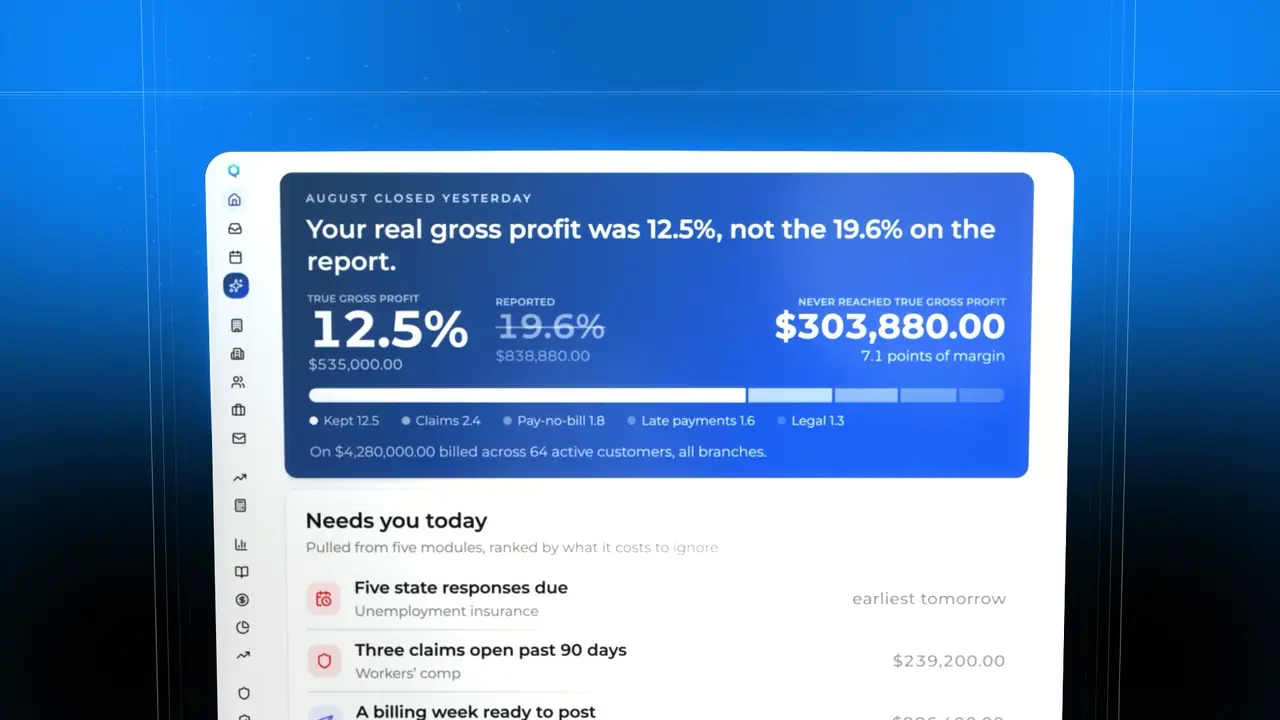
HubIQ is the co-pilot for running your agency. It connects your existing ATS, accounting and risk context so true gross profit reflects claims, legal costs when allocated, and unbilled pay, not only the original bill-pay spread.
ASC Staffing Group's Adriana Melendez says HubIQ gives branches answers the same day instead of the same month, alongside better work comp and UI claims control. Automated alerts and HubAI Q&A help teams act on connected records rather than waiting for a reconciliation cycle. Customer experiences are not guarantees.
Compare the operating approach
Category-level patterns, not an exhaustive feature audit. Capabilities depend on source data, configuration, licensing and refresh cycles.
| Consideration | Spreadsheets | HubIQ |
|---|---|---|
| Best use case | Ad-hoc analysis and one-off scenarios | Ongoing connected staffing decisions |
| Replaces your ATS? | No | No |
| Data freshness | As current as the last export and reconciliation | Connected source data, with source timing still relevant |
| Labor required | Recurring merges and re-keying | Hands-on setup followed by connected workflows |
| Version control & auditability | Depends on workbook discipline | One governed view with role-based access |
| Claims/contracts/legal linkage | Manual references and separate sheets | Connected Risk, Contracts and Legal context |
| Multi-branch consistency | Requires aligned formulas and refresh cycles | Shared definitions across connected branches |
Who should choose which
Keep spreadsheets
For a short-lived model, an exploratory calculation or a one-off analysis where the sources and assumptions are explicit.
Use HubIQ
When recurring exports have become the operating system for margin and risk, and branches need a consistent answer before the month closes.
Talk through your agency's stack
HubIQ, Inc. is headquartered in San Francisco. Bring the systems and reporting questions your team already works with.
Common questions
Curious whether HubIQ fits the ATS and branches you already run?
We’d be glad to talk.